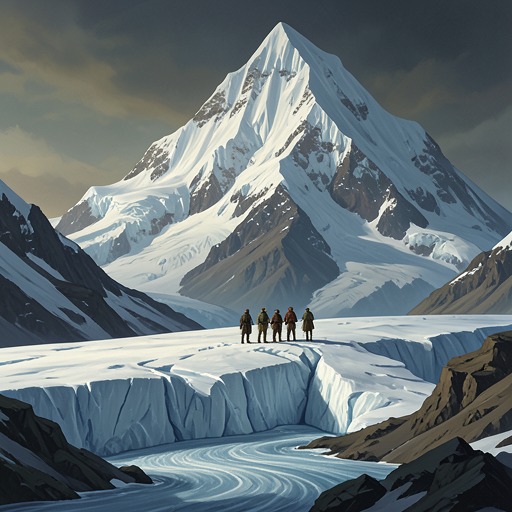
Vatnajökull, the glacier that buries and gives history back
Operation NapoleonVatnajökull Glacier is more than the setting of a vanished German aircraft: it is the novel’s image of history buried, altered, and unexpectedly returned. Snow and moving ice frustrate the 1945 search, then decades later the aircraft’s reappearance revives the questions that its disappearance seemed to close. The glacier preserves the past, but not as a stable record that can simply be consulted. What emerges is partial evidence, carrying the weight of years of uncertainty and the consequences of what people chose to forget.
A Search at the Edge of the Ice
In the winter of 1945, Colonel Miller led an expedition toward the glacier after two brothers living near the ice cap reported seeing a German plane fly low past their farm. The route from the farm was passable, but the soldiers had little experience on glaciers; the brothers guided them around crevasses and gullies to a camp roughly 1,100 metres above sea level. The circumstances made the search physically and practically precarious. The winter day offered only a short window of light, and the troops had to divide their effort between the foothills and the ice.
For three weeks, the soldiers searched the glacier’s slopes and five square kilometres of the ice cap. At the end of each day, they gathered at the farm base camp, where they ate, slept, and sang songs the brothers recognized from the radio. On the ice they had British-issue mountaineering tents, double-layered silk, primuses and oil lamps; their heavy leather coats and Icelandic-wool gloves belonged to an expedition trying to work against cold and darkness as much as against the scale of the landscape. These details make the search a sustained human effort, not an abstract failure: men and equipment are set against terrain whose conditions repeatedly exceed their control.
The expedition found no wreckage in the searched area, but it did find the rim of the aircraft’s nose wheel about two kilometres onto the ice cap. Colonel Miller took charge of the fragment. Beyond it, the surface appeared smooth, with no visible sign of a crash or forced landing. The brothers suggested that drifting snow might already have covered a plane that had come down there. The crucial evidence was therefore also an absence: the wheel established a connection to the aircraft, while the unmarked ice left its location unresolved. The glacier had not simply hidden a known wreck; it made the distinction between disappearance and burial impossible to settle.
From Burial to Return
The first search ended without locating the aircraft. Severe weather hampered the expedition twice, and a later storm buried tents and other equipment in snow, which was lost for good. Colonel Miller eventually had to abandon the operation. His persistence had impressed the brothers, who came to respect and assist him, but determination could not overcome the conditions on the ice. The episode sets the pattern for the glacier’s role: human inquiry can establish traces and make informed guesses, yet the landscape controls what can be seen and when.
Decades later, Carr explains the aircraft’s renewed appearance by describing Vatnajökull Glacier as a moving system rather than a fixed container. It covers 3,200 square miles, includes several active volcanoes, and consists of smaller glacial tongues whose ice mass changes with climatic variation. In his account, something lost in the ice may resurface decades afterward. That explanation gives the return a physical cause, while preserving its unsettling temporal effect: the aircraft is not newly arrived, but newly available to the living. Carr also tells the Secretary that the earlier expedition was mounted from Reykjavík a few days after the wartime crash, when winter visibility on the glacier was close to zero. The wreckage, buried by snow and eventually swallowed by the glacier, is now returning after a lifetime.
The small piece of metal that survived the first search takes on renewed significance when Carr examines the wheel again. Its inscription, Kruppstahl, identifies its material; its make corresponds with the aircraft’s type, size, year of manufacture, and capacity. Carr remembers that this wheel alone had confirmed the crash-landing. Now that the aircraft has been found, the old fragment becomes more than a remnant: it is the link between a failed search and the later recovery, proof that the present discovery belongs to the same unresolved history.
The Past Preserved in Ice
For Miller, the glacier’s capacity to preserve is inseparable from the human cost of what it holds. He recalls that the winter of 1945 was unusually harsh and that snow above the farm did not melt until July. He believes the fuselage may remain fairly intact beneath the ice and that the bodies inside may be preserved as well, frozen for more than half a century. His thoughts turn the aircraft from an object of military or historical investigation into a sealed human scene: the cold may have kept its occupants close to the condition in which they disappeared.
Miller imagines the years as successive layers of snow and ice, accumulating winter after winter and blizzard after blizzard over what he calls a frozen casket. The image gives geological time a particular emotional shape. Each layer increases the distance between the dead and the world, even as the glacier preserves them. The aircraft’s possible intactness does not mean that time has stopped for everyone around it; Miller has spent his life searching, grown old, and now fears he may not live to see the plane. Preservation in the ice therefore carries a paradox: it safeguards a past moment while making its eventual return more painful for those who have continued living.
His expectation that the occupants might still look as they did in 1945 intensifies that paradox. Miller keeps thinking about the temperatures and the possibility that the glacier never rose above freezing. He describes the prospect of seeing the pilot as like going back in time. The image is not evidence that the dead will literally be unchanged in every respect; it is Miller’s understanding of what the cold might have done, and of what the recovery could mean to him. The glacier seems to offer access to a past scene, but that access is inseparable from the knowledge that the scene contains dead people.
Recovery and the Burden of Knowledge
The aircraft’s return does not settle the meaning of its history. Instead, it reopens the work of interpretation: the first expedition’s fragment, the brothers’ sighting, and Carr’s account of glacial movement must be brought together to establish what happened. The glacier has preserved clues unevenly, releasing a wheel before the wreck and making a later discovery possible without making the intervening decades transparent. Physical recovery can expose what was hidden; it cannot by itself restore all that was lost or erase the decisions made around the aircraft.
Miller even wonders whether it would have been better for everyone if the glacier had kept the plane forever, so that no one would have to worry about it. His wish sits against his lifelong search and the excitement of finally learning that the aircraft has been found. He has wanted the wreck returned to view, yet recognizes that its recovery may bring new burdens. His remark that the plane may be the only reason a base was established in Iceland widens the object’s significance beyond his private pursuit: the aircraft is bound up, in his mind, with a much larger military history.
The glacier’s defining action is thus neither simple concealment nor uncomplicated revelation. It buries the aircraft deeply enough to defeat the 1945 search, preserves it through decades of ice, and eventually gives it back when its movement makes that possible. The return turns an old absence into an active problem in the present. Vatnajökull becomes an archive without an archivist: immense, shifting, and selective in what it yields, holding history beyond human reach until its traces resurface and demand to be faced.